-
So what kind of bicycle or horse do you ride to work and travel around on?
Leave a comment:
-
Only very partly true. It might be true that every year as much oil bubbles out of the ocean floor as Bungling Petroleum spilled this year. That amount is spread out over many, thousands, maybe millions, of points. At each point, the rate is relatively low and goes on for years, decades or centuries. The marine microflora is adapted to break down the petro at these points. This does not happen instantly and it can not do it at the rate to match the evil spew from BPs well.Leave a comment:
-
Here is the deal. Oceans and Petroleum have co-existed for billions or years, and will continue to do so for billion of more years long after man turns to dust. More petroleum seeps naturally into the oceans than man can ever spill into it. Mother Nature or whatever you want to call it has a plan and mechanism's worked out to do deal with it perfected over billions of years. All man has to do in our blink of time on earth is learn to adapt to it. Mother Nature will be just fine.Leave a comment:
-
What the quoted paragraph means to say is that their past detection methods leave a lot to be desired. Note that plenty of things that you can't smell or see will kill you. Carbon dioxide at normal concentration of about 0.04%. At 5% it will make you stupid, fall down and die in that order. You can't see or smell it.
He may have been speaking about a particular depth. since It is contradicting other evidence from the same group. I appears that cameras passing through the same plume had oil droplets sticking to their camera lens.
I believe that the correct take-home message is that there is a lot of oil at concentrations that are troublesome and may take a long time to disperse and break down.Leave a comment:
-
Quote, 'The underwater oil was measured close to BP's blown-out well, which is about 40 miles off the Louisiana coast. The plume started three miles from the well and extended more than 20 miles to the southwest. The oil droplets are odorless and too small to be seen by the human eye. If you swam through the plume, you wouldn't notice it.
"The water samples when we were right in the plume look like spring water," study chief author Richard Camilli said. "You certainly didn't see any oil droplets and you certainly didn't smell it."
For the article - http://news.yahoo.com/s/ap/20100820/...il_spill_plume
Certainly sounds like dangerous stuff to me! The article is less optimistic than the quote but as all is in unknown territory?Leave a comment:
-
Not to worry - in a few years people will look back and wonder what the fuss was about.
The professors who are screaming will have changed their story and be saying 'I told you so' as well.
Stuff happens - let the law go after BP and maybe they can do some good. Enforce the rules for drilling and forget about the environmentalists ban on the continental shelf.
If we make it too tough to drill then Cuba can allow the Chinese to come drill in their waters. Then the GOM gets all the negatives plus-plus and zero benefits. You know good old Fidel would love that - he might even sabotage the rig just to create havoc.
Obama could threaten them all he wants and they would tell him to PO.Leave a comment:
-
And let's keep it that way in the future since we have already doubled this year's quota. In addition, it is not just how much, but where and how much.
The authors are obviously a bunch of no-nothing, ivory-tower, egg-heads since they think leaked oil from human activity is a problem:
> If oil is natural to the oceans and if it is the biggest source of input, what
> is the fuss about oil as a pollutant? The answer lies in the locations and
> rates of oil inputs. Oil seeps are generally old, sometimes ancient, so the
> marine plants and animals in these ecosystems have had hundreds to thousands
> of years to adjust and acclimate to the exposure to petroleum chemicals. On
> the other hand, the production, transportation, and consumption of oil by
> humans often results in the input of oil to environments and ecosystems that
> have not experienced significant direct inputs and have not become acclimated.
>
>
> Biological and physical processes can reduce the concentration of oil
> chemicals in an ecosystem, especially if the source of pollution is cut off.
> As concentrations decline and chemical compositions change, plant and animal
> communities usually rebound. But the recovery can range from months to decades
> depending on the chemistry, the conditions, and the organisms and ecosystems
> affected.
and moreLeave a comment:
-
-
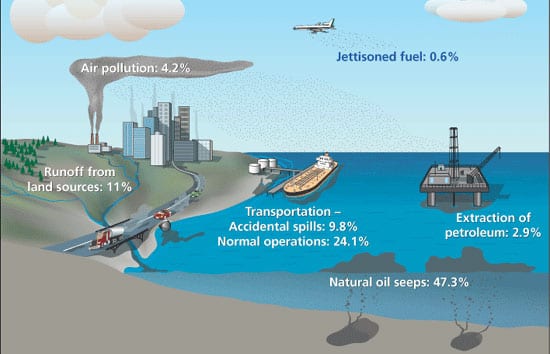
According to the National Research Council, it's estimated over 600,000 tons per year.
Natural processes are responsible for over 60 percent of the petroleum entering North American waters, and over 45 percent of the petroleum entering the marine environment worldwide.
Some other articles regarding this subject:
Leave a comment:
-
First, what is the source of the calculation of 600,000 metric tons/year, the oil companies with a vested interest in minimizing the magnitude of the spilled oil, or the previously-discredited academic, no-nothing egg-heads?
Second, according to my calculations on the back of an envelope, your figure is about equal to what is generally-accepted to have been spilled, minus what BP says they recovered. That is in about 1/3 the time and relatively close to an environmentally-sensitive area that produces most of the sea food that is caught in the Gulf. That marshland is also important for attenuating the energy of tropical storms that affect low-lying populated areas.
I am concerned. Since we can't predict what it will do, the prudent action is to try to predict the worst-case outcome and plan accordingly. Obviously BP did not do that in their drilling operation or they would have planned a better response and had it ready before the well blew up. Prudent can not describe the poor maintenance and intentional disabling of some of their safety equipment.Leave a comment:
-
Natural oil seeping into ocean waters has gone on since the beginning of time. Currently it is estimated at a rate of 600,000 metric tonnes per year. The spill in the Gulf as tragic as it appears is a drop on the bucket compared to what seeps naturally into the seas from underneath the ocean waves.Leave a comment:
-
You can not reasonably say that pointing out a logical fallacy is meaningless in day to day life. Credit Sagan with pointing it out in a cute way.
"Absence of evidence is not evidence of absence" is another way of saying that these are not logical:
A has never been disproven therefore A is true.
A has never been proven therefore A is false.Leave a comment:
-
The Carl Sagan quote is cute but meaningless in day to day life.
Kind of like saying, 'I wish' or 'I hope'. Two of the most stupid statements man can make.Leave a comment:


Working...
😀
😂
🥰
😘
🤢
😎
😞
😡
👍
👎
☕
Leave a comment: