X
 
  • Time
  • Show
Clear All
new posts
  • Perry
    Solar Fanatic
    • Feb 2011
    • 120

    #1

    170 Watt PV System

    Does this look the right way to hook up two 85 Watt Panels, a Charge Controller, Batteries and an Inverter?
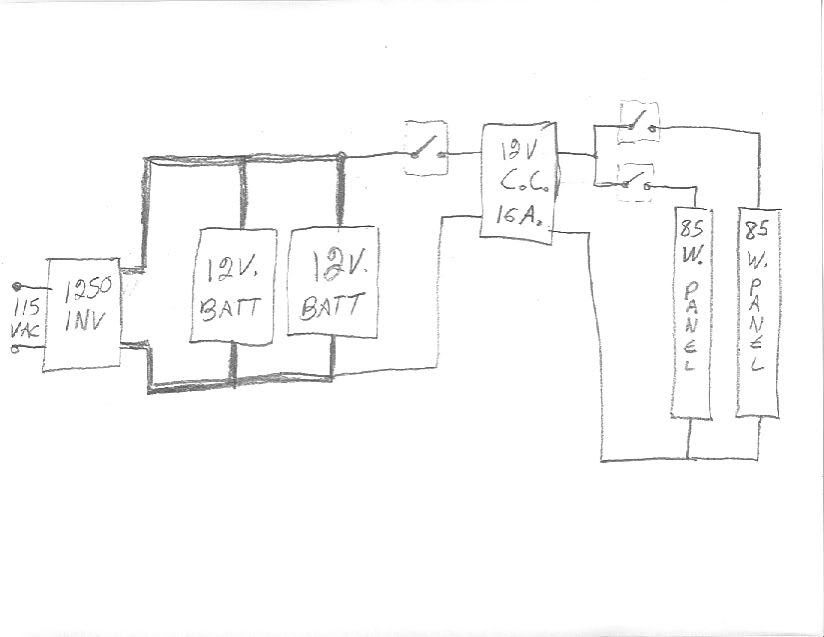


    Couple other questions?

    Can I use regular 12 Gauge Underground Feed (12-2 UF w/G) feed to wire the panels & charge Controller?

    Can I use regular house wiring with 20 Amp switches and electrical boxes to wire up the switches? (yes, I know I need heavier gauge wire between the batteries & Inverter)

    Any other comments?

    EDIT: try this to see the whole layout:

  • Mike90250
    Moderator
    • May 2009
    • 16020

    #2
    It looks like it just needs a fuse at the + terminal of each battery.
    Powerfab top of pole PV mount (2) | Listeroid 6/1 w/st5 gen head | XW6048 inverter/chgr | Iota 48V/15A charger | Morningstar 60A MPPT | 48V, 800A NiFe Battery (in series)| 15, Evergreen 205w "12V" PV array on pole | Midnight ePanel | Grundfos 10 SO5-9 with 3 wire Franklin Electric motor (1/2hp 240V 1ph ) on a timer for 3 hr noontime run - Runs off PV ||
    || Midnight Classic 200 | 10, Evergreen 200w in a 160VOC array ||
    || VEC1093 12V Charger | Maha C401 aa/aaa Charger | SureSine | Sunsaver MPPT 15A

    solar: http://tinyurl.com/LMR-Solar
    gen: http://tinyurl.com/LMR-Lister

    Comment

    • Perry
      Solar Fanatic
      • Feb 2011
      • 120

      #3
      Originally posted by Mike90250
      It looks like it just needs a fuse at the + terminal of each battery.
      Yeah, I saw those fuses that you posted the other day that mount to the battery terminals. I can put those on if necessary.

      My existing inverter has four thirty amp fuses on the input side and currently, the inverter is hooked up directly to the battery terminals. Would additional fuses be required at the battery terminals if the inverter is already fused at 120 amps?

      Comment

      • Mike90250
        Moderator
        • May 2009
        • 16020

        #4
        fuses are to protect the wires, in case they get shorted somewhere after they leave the power source. At the inverter is a poor location.
        Powerfab top of pole PV mount (2) | Listeroid 6/1 w/st5 gen head | XW6048 inverter/chgr | Iota 48V/15A charger | Morningstar 60A MPPT | 48V, 800A NiFe Battery (in series)| 15, Evergreen 205w "12V" PV array on pole | Midnight ePanel | Grundfos 10 SO5-9 with 3 wire Franklin Electric motor (1/2hp 240V 1ph ) on a timer for 3 hr noontime run - Runs off PV ||
        || Midnight Classic 200 | 10, Evergreen 200w in a 160VOC array ||
        || VEC1093 12V Charger | Maha C401 aa/aaa Charger | SureSine | Sunsaver MPPT 15A

        solar: http://tinyurl.com/LMR-Solar
        gen: http://tinyurl.com/LMR-Lister

        Comment

        • john p
          Solar Fanatic
          • Oct 2010
          • 738

          #5
          Every time I read you should put fuses on the battery terminals to protect the wires to the inverter I have to really wonder about that person and if they just say that because they always say that?.
          If you use short lengths of cable (2ft) how can there ever be any possibility of the cables shorting somehow somewhere in that distance?? damm impossible.And if you really believe its a possibility why not put the cables inside lengths of plastic tubing covering them from terminal to terminal ?????
          The more fuses you unnecessarily use the more connections you have with REAL losses at those connections. This is going to be very much the case when its a 12v system and using and a high current draw inverter.

          Comment

          • Perry
            Solar Fanatic
            • Feb 2011
            • 120

            #6
            Originally posted by john p
            If you use short lengths of cable (2ft) how can there ever be any possibility of the cables shorting somehow somewhere in that distance??
            I was wondering the same thing. My inverters cables are currently 18" long and are insulated. I have been using inverters to power equipment for the last 10 years and have never seen terminal mounted fuses. I would think if it was dangerous, the inverters would come supplied with terminal mounted fuses. For that matter, it would seem like all vehicles would also have fuses the battery terminals to prevent shorting of the battery cables under the hood.

            Comment

            • john p
              Solar Fanatic
              • Oct 2010
              • 738

              #7
              Perry you are correct as far as I understand the real world.. they more likely to create problems than solve a non existant problem..
              Its an imagined problem ,And the only place a fault might occur is in the inverter and it has fuses for that purpose.
              Anyone ever see a fuse on the battery of a vehicle going to the starter motor??/??

              Comment

              • Perry
                Solar Fanatic
                • Feb 2011
                • 120

                #8
                Originally posted by john p
                Perry you are correct as far as I understand the real world.. they more likely to create problems than solve a non existant problem..
                Its an imagined problem ,And the only place a fault might occur is in the inverter and it has fuses for that purpose.
                Anyone ever see a fuse on the battery of a vehicle going to the starter motor??/??
                I found out that that inverter makes quite a spark when you hook the battery terminals up backwards when all four 30 amp fuses blow at once.

                Comment

                • john p
                  Solar Fanatic
                  • Oct 2010
                  • 738

                  #9
                  You lucky they all blew as sometimes they dont and thats the end of the inverter.
                  Im a bit worried you only have had no problems with inverters and no battery fuses for only 10 yrs,, You will have to wait until 11 years before you can be really sure its safe to do
                  Its well know for inverters and amplifiers the output transistors are there to protect the fuses..

                  Comment

                  • Sunking
                    Solar Fanatic
                    • Feb 2010
                    • 23301

                    #10
                    Originally posted by john p
                    Perry you are correct as far as I understand the real world.. they more likely to create problems than solve a non existant problem..
                    That is a scary statement my friend and irresponsible.
                    MSEE, PE

                    Comment

                    • Perry
                      Solar Fanatic
                      • Feb 2011
                      • 120

                      #11
                      Hey, I can put the fuses in if they are necessary. Here's the smaller of the two inverters I use. (800W/1600W)


                      You really think I need a fuse here?

                      I mean I can understand if I have 20 batteries or something....

                      Comment

                      • john p
                        Solar Fanatic
                        • Oct 2010
                        • 738

                        #12
                        IM waiting for Sunking to explain to me why doing what you are doing is "scary and irresponsible""
                        I can see no possible way those cables can EVER short together...HOW???? they both plastic covered.
                        I think there is more chance of a aeroplane crashing into your house and landing on the batteries and the acid spilling over the floor .
                        Perry your clips on the battery cables are .NOT GOOD use proper terminals.

                        Comment

                        • Sunking
                          Solar Fanatic
                          • Feb 2010
                          • 23301

                          #13
                          Originally posted by john p
                          IM waiting for Sunking to explain to me why doing what you are doing is "scary and irresponsible""
                          I can see no possible way those cables can EVER short together...HOW????
                          That is because you are not thinking. I can think of 4 real documented possibilities right off the top of my head.

                          1. Mr careless home owner or old technician removes or connecting cable from battery to inverter, removes hot battery cable from input of inverter, cable slips out of hand and exposed conductor makes contact with chassis or return conductor.
                          2. Same scenario as #1 except uninsulated wrench slips, or rounds off nut causing wrench to to make contact with chassis or return terminal.
                          3. Or dumb homeowner or technician connects battery input to inverter with polarity reversed causing reverse polarity diode to forward bias.
                          4. Something falling on the conductors causing one or both conductors to be pulled out from inverter.

                          All above are real possibilities and have happened, even to you if you are a technician.
                          MSEE, PE

                          Comment

                          • john p
                            Solar Fanatic
                            • Oct 2010
                            • 738

                            #14
                            (1) a few harmless sparks would occur in worst case. as the hot cable cant stay in that position by itself
                            (2) they are screw on plastic binding posts with metal inserts
                            (3) it has internal fuses in inverter to protect against that.and he has had that happenand it survived
                            (4)the conductors cant pullout of inverter as they have ring ends and the screw on "nuts"

                            It hasnt happend to me as I have always connected the cables first to inverter or device than final connection to battery, was taught that half a century ago, at same time I learnt to read and understand simple schematics.

                            Comment

                            • john p
                              Solar Fanatic
                              • Oct 2010
                              • 738

                              #15
                              Sunking We all think you need glasses as you seem to have a vision problem ..You showed you cant see very well also in the post "12v AC to 12v DC". Have another careful look at Perrys inverter its the same as thousands on inverters below 600w it has plastic "nuts" over the input posts ,NO tool is used on these types of terminals so that instantly eleminates that possibility .,its virtually impossible for ANY of the possible reasons you gave for any problem to occur by not having a fuse in the cable near the battery,, And anyway how do you stop a careless poor vision electrical engineer dropping a metal tool across the battery terminals,?? How you fuse protect that??
                              And why did you not advocate the use of a fuse at the battery end of the charge controller cable as another clumsy electrical engineer may pull out the cables from the CC and have them contact each other ??
                              And what you suggest for strings of cells ?? A fuse between every one??? and how will that protect a cell if the clumsy person using a spanner touches the other terminal of the cell or tools get dropped on the cells while they are being connected together ??
                              In just about all instances battery terminals on large lead acid batteries are exposed . People working with them have to exercise some degree of care.The answer is not to apply endless fuses to try to protect against all possibilities and as you know no amount of fuses can protect the battery/ies from people using tools on them in a haphazard way... EVERY connection in a high current 12v battery system is a potential source of voltage loss and danger from overheating and possible fire.and a fuse is not goint to stop that problem..
                              Mabe you can go make a fortune by manufacturing ceramic spanners and screwdrivers and retractable covers for the ends of all cables ,then your clumsy and or incompetent engineers and electricians will never have short circuit probles again working with batteries.

                              Comment

                              Working...