
That 10% tolerance number is on the very outside of acceptable. Not sure what your source is that this is good or desirable. Such an excessive range can cause all sorts of problems with household devices.
ANSI C84.1. Is what most utilities aspire to, preferably Range 1. That is also what my utility uses as a target.
And thank you very much for the kind words.
-
-
Thanks for the report on the problem and the solution. Seems this
is not such an unusual thing. Here the guilty seem to downplay it
as a "temporary" thing, just wait and it will go away. I see it as the
value of my system going right down the toilet for no good reason.
Renewable energy cannot just be made up later, it is gone.
Bruce RoeLeave a comment:
-
The problem has been solved, and I wanted to post an update to let you know what was the culprit.
Turns out there was nothing wrong with the equipment. My grid voltage had crept up over time, reaching at times 256 volts. My Sunny Boy was more accepting of the high voltage than the IQ7+ inverters, but when it, too, eventually started to cut out for longer periods, I knew something was wrong.
The utility people came out at first, wanting to tell me that 127V on one leg was “perfect”. Naturally, that was a bunch of nonsense. I made a call to higher management, and they promptly instructed the crew to adjust it. Turns out they somewhere in the system “forgot” a capacitor bank that they removed. They ultimately admitted that this was an oversight and their fault and even thanked me for “discovering” it. The removal of that bank permanently brought down the voltage to below 250V/125V. I have that manager on speed dial if it ever causes problems again. I suggested a tap adjustment on my transformer pole, but as of now that doesn’t seem to be necessary.
Goes to show that you have to do your own investigation and insist when professionals shrug your concerns off at first. Altogether, I have to say that the utility came around and clearly showed their willingness to help. I have perfect production now. No more dropping out of any of my inverters.
Thanks all for chiming in previously with your ideas and support! I much appreciate the helpful attitude of forum members here.Leave a comment:
-
Haha. Never mind. Another grid “event” occured this morning, micros are out again, and string inverter is fine, as always. I suppose I need to get my magnetic boots on and climb on the roof to investigate the status LEDs. I will report my findings.Leave a comment:
-
Phil, while I read your last reply, I noticed that my inverters were starting up at 12:07 pm for two days in a row. Then, surprisingly, the day after, they reverted back to normal and have now been operating normally for two, three days.
vexing, really. I assume that whatever firmware controls them has some sort of internal logic to reset itself after an incident, I did not get a chance to read the status LED when they were not functioning properly (I was sick then, didn’t want to climb on my slippery metal roof), but I am 100% certain, that there is no negative interaction between my SMA and the micros.
Anyway, since the micros are back in business, I will let them be for now and watch how they keep performing. I do not know whether a possibly newer firmware would solve my specific problem. If they kept malfunctioning, I would pursue a warranty claim with Enphase. As things are, I will wait and see.
the problem is that Enphase has not published any specific protocol about how their inverters will perform during certain situations. What are the scenarios that could trigger such behavior? For how long will the inverter be locked out during, say, repeated grid failure incidents, etc? There is a huge black box that the manual and their technical literature does not address.
Anyway, mainly just glad that my micros are making power again. Getting ready for 100+ deg. F weather here in the next few days.Leave a comment:
-
I am not an installer and have not owned Enphase equipment so there is limited additional help I can offer. You have about $600 worth of inverters and the envoy costs about $500, but you have no way to communicate with your Enphase devices.
For the SMA inverter, I assume you do not have a -40 and therefore do not have access to real time DC & AC variables.
I can only thing of two other things to try.
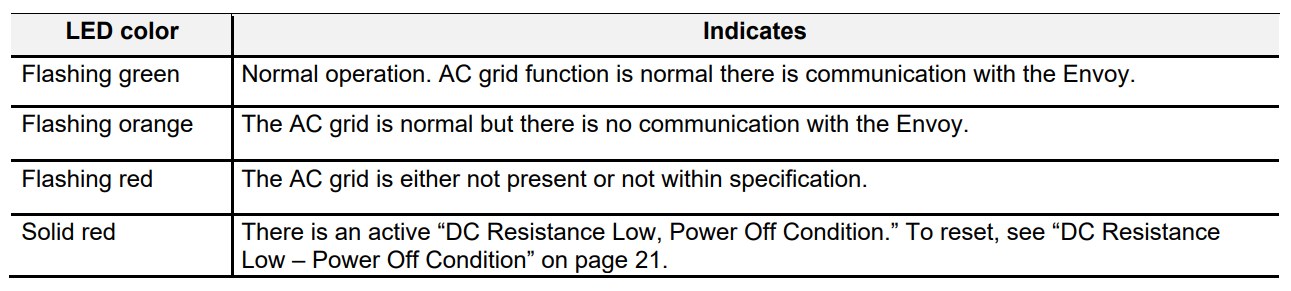
1) Keep both systems as is, if the SMA system starts up and the Enphase system doe not, then go read the LED's on the Enphase devices.
2) Turn off the SMA inverter and Turn On the Enphase system to see if there is an interaction problem. You already know the SMA inverter can run by itself.
BTW, I can't upload a PNG or JPG file either.Leave a comment:
-
Hi Phil. Thanks so much for pulling this up. Very useful! I fall into the "not required" category (inverters purchased and commissioned in May 2021). When I get some time next week, I will put together a nice documented warranty claim and send it directly to their Austin office. I hate dealing with their offshore support. There seems to be a disconnect, and they don't strike me as readily wanting to help.
I suppose there is no known way to reset these inverters at least to factory setting? Naturally, I haven't disconnected them at the DC leads, assuming that any such reset would occur at night automatically. Currently, they are haphazardly coming on (or not). Today, for instance, they all came on simultaneously in the early afternoon. Annoying, but at least some electricity until I get this figured out. Once they come on, they stay on until sunset.
Would you agree that I need to receive replacement units before sending the old ones back? If the other way around, then all connections would be susceptible to moisture ingress.
Leave a comment:
-
If the system was activated after November 19, 2021 then warranty includes the paragraph:The Covered Products should be continuously connected to the internet during the warranty period, except where interrupted by causes outside of the Covered Owner’s reasonable control. This will help ensure that potential defects in the Product can be diagnosed remotely and that the Product can receive over-the-air firmware updates
If the system was activated between January 1, 2021 and November 18, 2021 then the previous paragraph is not included in the warranty; system not required to be continuously connected to the internet.But the warranty contains a very curious paragraph:
For the avoidance of doubt, software programs installed in the Covered Products and the recovery and reinstallation of such software programs and data are not covered under this Limited Warranty. Enphase does not warrant that the operations of the Covered Product will be uninterrupted or error-free. No Enphase employee or authorized reseller is authorized to make any modification, extension, or addition to this Limited Warranty. If any term of this Limited Warranty is held to be illegal or unenforceable, the legality or enforceability of the remaining terms shall not be affected or impaired.
This paragraph is vague and can be read many different ways. One way to read it: We don't cover reading your firmware/data or reinstalling firmware/data; product interruptions and errors happen.
From Enphase RMA process:If in-field troubleshooting of the Enphase product is not able to be accomplished because the Envoy device does not exist or is not operational and the unit is determined upon receipt and testing by Enphase personnel as being fully operational (no trouble found), the owner will incur a $200 handling fee.FWIW, the SMA system warranty has no reference to "must be connected to the internet" or anything about firmware/data exclusions.
Unfortunately, I do not know of a backchannel Enphase contact.
Leave a comment:
-
Had a horrible experience with Enphase customer service. They cannot help me because they cannot "see" the problem because I don't have Envoy. Technically, their warranty is not tied to Envoy, since Enphase doesn't require the purchase of Envoy.
The offshore representative who assisted me was not helpful. I provided him with monitoring data to support my claim. He then sneakily told me that he had to talk to his superior about this and that I would hear from him later. Naturally, that was a nice way to get rid of me. He also didn't bother to look at the data. Not sure he even understands it or bothered to look at it closely.
I will keep fighting. I am putting together my own screenshots of my data monitor so I can submit them as evidence of the irregular production pattern of these inverters.
Aside from contacting the offshore reps. through their usual channel, does anyone know of a backchannel I can contact? If nothing works out, I will submit a detailed complaint with corroborating evidence to the corporate headquarters in the U.S.
In my view, this is a very clear warranty issue, and I will pursue this. Not impressed with Enphase so far at all. I also very much doubt that these inverters will actually last 25 years in the elements.
Leave a comment:
-
Thanks all for your feedback. My Sunny Boy inverter is back to normal operations. No problems. Ever since the grid event, the four IQ7+ inverters are unpredictable. Sometimes they come on, sometimes they don't. Sometimes it's just one or two, sometimes all four are on. I can tell from my eGauge monitoring device.
Those IQ7+ were installed in May 2021 new out of the box by me. I have the serial numbers and have registered them with Enphase. I will open a warranty claim. I think that you might be right with the firmware problem. I WILL NOT spend another $500+ to get the Envoy. Waste of money for my small array. I hope that Enphase will send me updated replacement inverters. I will gladly send these back to them.
What a hassle. These products get released and then have issues. Not impressed with Enphase so far. Hopefully, their warranty service is better. In comparison, my SMA Sunny Boy hasn't skipped a beat in more than eight years.Leave a comment:
-
I agree that Quality Meters are not something most homeowners have. My job allowed me to use a Fluke 435 which did a great job in capturing the issue. But they cost somewhere above $8k and require some understanding to set them up.
Still the POCO may be working on their grid problem if it is causing them issues. But most use capacitors to keep the voltage within spec but end up causing harmonics down the line which affect their customers. It is a bad situation which I feel more homeowner's solar will just aggravate the issue unless the POCO's are installing the system and hopefully have worked on controlling the side affects.
We are in a state of flux which will give some people heartburn and others more money.Leave a comment:
-
I know of a couple of installations that started with opening up the grid tolerances. Both were Fronius and they called Fronius service. They were given a password to open up the parameters. In both cases it helped but did not solve the problem. Once the utility got involved and hooked up power quality meters, the problems got solved after a week or two. In both cases it was the local grid faults. One of them was a big capacitor bank on some large pumps that were racking in at the wrong time, the other case was an old hydroelectric plant with ancient controls that had been damaged in a flood, the utility was planning on getting rid of it so they were trying to control it from a remote dispatch center without the local control and letting the voltage go out of tolerance. In another case the utility had a tap changer on a transformer that had the wrong setpoints.
When wind turbines were starting to go on the grid the utilities used to fight the installations saying the large loads were screwing up the rural grids they were connected to. The folks who designed the wind turbines at my former employer claimed that in many cases they were getting blamed for problems with existing power quality issues already present. The NP turbines were Permanent Magnet turbines so they had power electronics anyhow to form a stable AC output so it wasnt that hard to put in power electronics to stiffen up the local grid. I think the AC turbines are equipped to do the same thing. .
BTW the normal utility approach is that its not their problem, they want the person making the complaint prove it to them. Unfortunately calibrated power quality meters are expensive and not many homeowners have access to them. In the two cases, Fronius could tell by the codes the inverters were throwing that it was grid overvoltage events that were taking the inverters out. The initial individual called the power company a few times and only when the PUC was brought up before they brought a power quality meter over and left it for a week.Last edited by peakbagger; 05-30-2022, 06:58 AM.Leave a comment:
-
I agree the grid changes and can fall outside it's normal operating parameters. Which is why a solar inverter turns off for a period of time. I was on a job up in Nevada where a high school with 1MW of panels kept going off line because they were on a feeder that also had a high load (big hp water pumps) that would turn on and off causing the grid to fluctuate and the solar inverters to go off line.
We partially solved the issue by changing the parameters of the solar inverters to be less sensitive and they stopped turning off. Now I am not sure what it may take to modify the OP's inverters but they may get farther asking the inverter company for help then going to the PUC to get the POCO to stabilize the grid.Leave a comment:
-
Grid faults happen but must homeowners without solar do not realize it. Lots of possible grid issues, there could be capacitor bank or tap changer causing the grid to go out of limits. Some grid companies are proactive and will install a temporary data logger on your supply to see if its operating in range. In some cases the utility could care less and a formal complaint to the PUC may be required.Leave a comment:



Leave a comment: