Bruce
I do not consider you a DYI since Solar Reviews labels you as a "Solar Fanatic". Ha ha.
You do bring up an interesting point - PV training schools use the IV curve traced to show the effects of partial shading on a module. it is interesting to see how the curve distorts when shade is applied and shifts as the irradiation value changes.
-
That looks like a convenient tool, too bad it is so expensive. Guess you are pushing me out of the DIY class if
I can set up such measurements? Since sun can vary a lot, comparing several modules under strong sun
has been the method for sorting out some weak sections here.
The response curves under partial shadowing are interesting, but I can surmise as much just by looking
at the array. Maybe the curve is needed to convince an owner just how devastating shadows are?
Bruce RoeLeave a comment:
-
Nice! Thank's Butch. Knock on wood, my panels seem fine so far. Just need to do something about those pesky trees (-:Leave a comment:
-
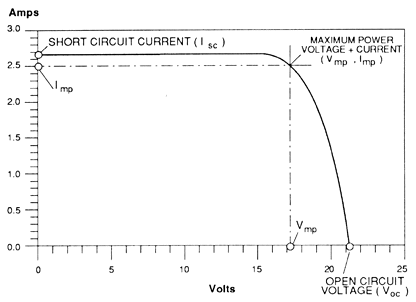
These are examples of the tool used to get an I V curve. this needs to be connected directly to a module or series string of modules. Capture.JPG
This tool is for use by professionals. my point is that there is a device out there which can determine if a module is performing properly or has an issue and that the big module manufactures wil honor their warranty when presented with this data.
If you truly believe that you have a bad module or cell then you hire a pro to run this tool on it. At that point you will know for sure.
I run this on every string of every project to document that the PV modules are functioning in accordance with the manufacturers specs.
BTW the device takes into account the cell temp and irradiance to produce the IV curves at actual and project STC.
From some of the previous posts it seems that many MFRs will honor the warranty from the solar edge or Enphase data so that you may not have to go this route.
I hope that this is helpful.Leave a comment:
-
As stated if you have solarEdge and have at least three identical modules in identical situation side by side you can use the graphs from solarEdge optimizers of the three modules to show that one is faulty. It really helps if you can find the point were the one module was performing on par with the others which isn't generally too hard to do either.Leave a comment:
-
So, to clarify, are the IV curve traces from SolarEdge panel level data (Charts => System => Inverter => String => Module => Current, Module Voltage) sufficient? Or do you actually have to lay hands on the panel with an independent, calibrated instrument from Fluke, etc?
Leave a comment:
-
Leave a comment:
-
An IV curve tracer is a specific device. all PV installers and maintenance companies should have one.
These are expensive for a homeowner to buy. Not it DIY tool.
The IV curve tracer graphs the Voltage VS current capabilities of a solar module and will indicate the Maximum power same as the MPPT in an inverter.
If there is a bad cell, diode or other it will show up on the graph.
The tracer can also build an IV curve for a string of modules in series as long as there are no optimizers. You can test an entire string this way.
Leave a comment:
-
That is just a plot of the panel output curve in strong sun? I suppose I could plot that with a dummy load and a
few measurements, getting it as a scope trace would be a little more effort. Maybe they never seriously looked
at it, just a means to see that you actually know something, and rejecting a lot of claims. Like my dental ins
asking to see a decade old billing, they found out some engineers never throw anything away. Bruce RoeLeave a comment:
-
Now that is nice especially since most home owners do not have the IV trace tool.
Another plus for Solar Edge.
Leave a comment:
-
-
Here is an update.
We just had a couple of modules replaced for two different customers for under performance .
The clients noticed the low performance thru the solar edge web site.
The kicker was that the MFRs ( SUNpower and LG) would not honor the warranty with out the IV curve data. So you need to have the tool to support your claim of low production even if you have module level monitoring.
But, once the IV curves were submitted they each shipped new modules.
Leave a comment:
-
Yep they are both good, pick whichever one is the best deal, and pay more attention to what type of inverter you are using. Panels basically never fail, inverter's do, spend more time looking into inverters, cheers.Leave a comment:
-
So does anyone have any input on LG panels vs Trina 300's?
Thank youLeave a comment:
-
 Guest repliedO does not apply as long as the scratch does NOT effect output.
P is saying that the warranty does not apply to normal wear and tear. Why would you expect a warranty to cover normal wear?
agree. Don't worry too muchLeave a comment:




Leave a comment: