
digital meter + shunt
Raymond , Have a look at this meter. I've been thinking of getting one myself. Rated at 50amps + shunt included. seller is "ithingsonlineshop"
http://www.ebay.com/itm/120730845144...84.m1436.l2648
-
Agree with you John simplest method is to just use a 50 amp shunt (assuming 50 mv full scale) and using a good DVM with an accurate mv scale as it keeps things simple. There are lots of suppliers and a shunt works in either AC or DC circuits.
With that said I do not know how useful a shunt would be for a operator and hard to justify the expense. Once the4 system is installed and verified, the shunt would not have much use. Since any system needs a good volt meter.I would recommend a good DVM with a clamp-on Amp meter to start with and forget about the added expense of a shunt and just use the meter when you need to measure current. You kill 2 birds with one stone and save money.Leave a comment:
-
But Mike he may have trouble finding a 1948 Hudson Hornet to get the ampmeter..??
Mabe it easier if he just goes to an electronics parts shop and either buys a 50a shunt and a millivolt meter or a 30a ampmeter,..Leave a comment:
-
you could get an old automotive ammeter with 2 terminal lugs on it, those often have the internal shunt, but only read in 5A increments.Leave a comment:
-
Raymondalmeda If you use a shunt you use a millivolt meter as shown in the simple drawing to read the amps usually 1a =1mv .if you dont use a shunt you just connect the 30a ampmeter as shown in the drawing where the shunt is. you dont need any diodes or anything else .Leave a comment:
-
This 30 Amp meter has a built in shunt. Just install it between the charge controller and the battery.
Leave a comment:
-
-
-
I added a 3' piece of #14 wire between the charge controller and the batteries. This is my shunt resistor. I calibrated it but snipping of bits of wire until it read the same as my 10 AMP multimeter. I think it's something like 0.002 ohms, so the voltage developed across this resister is 0.024 volts. THen you just need to buy or make a meter that will sense this voltage.
Or you could just buy this for 15 AMP DC ammeter for 8$
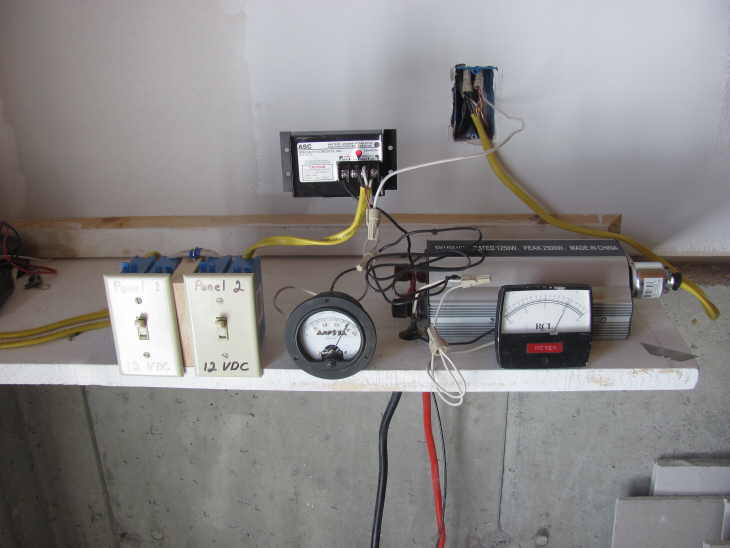
Leave a comment:
-
Are you asking for a permanent meter or test meter?
Both work the same way if using a shunt type meter. A shunt is a precision power resistor designed to develop 50 milli-volts at full scale reading.Leave a comment:
-
You need to buy a shunt (50a) but depends on what the aprox full amps you are likely to ever get from the panles.. its best to get a shunt size tso that your reading will be about half the shunt rating...wire it in series with the positive wire from the panels then connect a millivolt meter across the shunt to read the ampsLeave a comment:
-
Installing an analog ammeter
Hi,
Anybody here who knows how to install an analog ammeter to measure the current coming from the panels? I tried doing it by directly wiring the meter in series with the positive wire, it gives me a reading but it trips the controller after a few seconds. I heard from somebody that you ned to put a resistor and a diode so that it won't trip. By any chance anybody here knows if thats a true and if so, can somebody give me the diagram and parts needed?
Thanks!


Leave a comment: