Try our solar cost and savings calculator
Most Popular Topics
Collapse
Faulty AC Disconnect? You guys ever seen that happen?
Collapse
X
-
Seriously? The AC disconnect is a manual switch. It connects or disconnects a circuit when the switch is thrown.
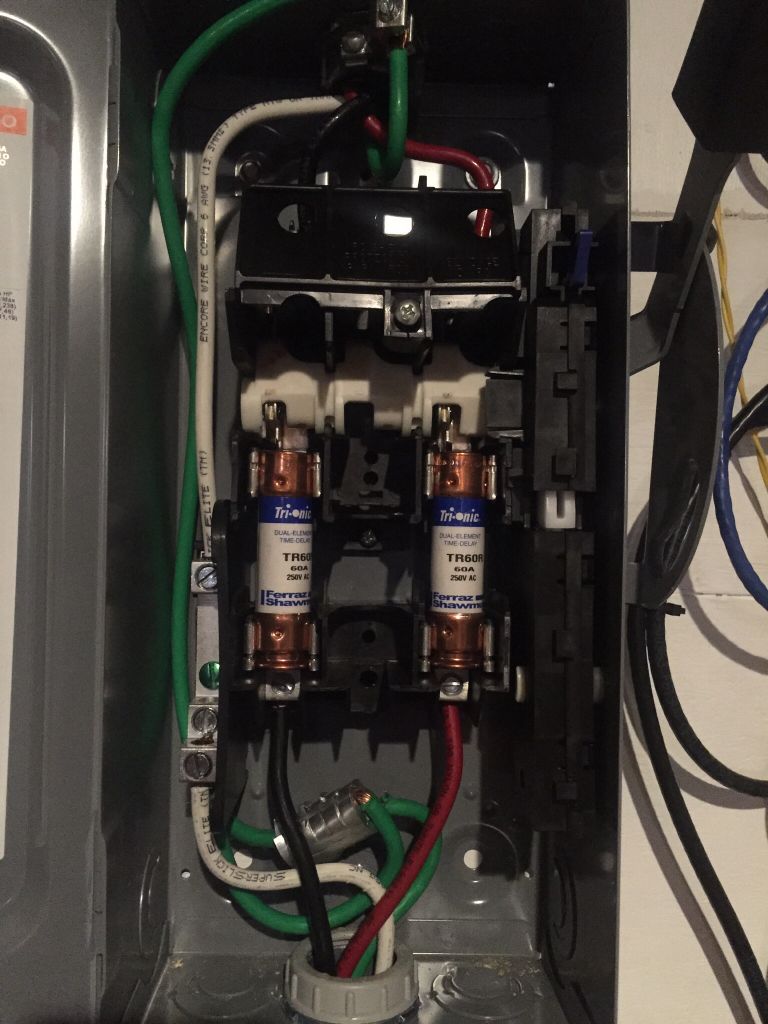
Fused disconnects contain an over current protective device (OCPD), and their presence in Mb190e's post lends support to the idea that his disconnect may be part of a line side tap, as DanS26 suggested. The OCPD for the OP's inverter's AC circuit is the circuit breaker in the service panel.Leave a comment:
-
I think he means the inverter will shut down.
It appears from your pic that the neutral and ground are bonded in the switch. If so, not code unless supply side tap.Leave a comment:
-
How does the AC disconnect "disconnect" if there's an issue without any fuses? Here's a picture of my AC disconnect.Those spring blades that make the contacts, are deadly. The metal is good for 1 bend only, bend it again and it's on it's way to crack or fail. Get it on line as is, but order a replacement. When the contact is bad, it heats up and starts to oxidize and get hotter - but your PV will disconnect first and stop a fire, but it's not doing yourself any favors keeping it around.
Leave a comment:
-
I figure it should have some sort of warranty? I'll get a hold of the manufacturer.Those spring blades that make the contacts, are deadly. The metal is good for 1 bend only, bend it again and it's on it's way to crack or fail. Get it on line as is, but order a replacement. When the contact is bad, it heats up and starts to oxidize and get hotter - but your PV will disconnect first and stop a fire, but it's not doing yourself any favors keeping it around.Leave a comment:
-
Those spring blades that make the contacts, are deadly. The metal is good for 1 bend only, bend it again and it's on it's way to crack or fail. Get it on line as is, but order a replacement. When the contact is bad, it heats up and starts to oxidize and get hotter - but your PV will disconnect first and stop a fire, but it's not doing yourself any favors keeping it around.Leave a comment:
-
Correct, the contact that made with the blades. The upper left contact was spread too far apart and the blade wasn't making good contact when it was switched on.By clamp are you talking about a wire termination or the contacts that mate with the blades of the knife switch disconnect?
If the switch contacts got spread apart, I would at least look carefully to make sure that when I bent them back the flat or curved contact surfaces are aligned just like the others and that the spring tension holding the contacts against the blades is close to that of the other line connection.
So just visually check it to make sure it looks the same as the others?Leave a comment:
-
Good idea. Chances are there is now more resistance on that left set of contacts.By clamp are you talking about a wire termination or the contacts that mate with the blades of the knife switch disconnect?
If the switch contacts got spread apart, I would at least look carefully to make sure that when I bent them back the flat or curved contact surfaces are aligned just like the others and that the spring tension holding the contacts against the blades is close to that of the other line connection.
If it was my installation I would just replace the switch with a new one. I would hate to see that whole system go up in smoke.Leave a comment:
-
By clamp are you talking about a wire termination or the contacts that mate with the blades of the knife switch disconnect?
If the switch contacts got spread apart, I would at least look carefully to make sure that when I bent them back the flat or curved contact surfaces are aligned just like the others and that the spring tension holding the contacts against the blades is close to that of the other line connection.Leave a comment:
-
I see what you mean now that you mentioned it. Nice job troubleshooting.Thank you guys for the OHM test suggestion...IT'S ALIVE!!
I wasn't getting any continuity across the left side with the disconnect on. Took a close look at the top clamp was too spread apart, took a screwdriver and bent it a little and boom, continuity restored! Everything is up and running and making POWER!
Leave a comment:
-
The disconnect came with that grease.This disconnect is what was called out on the permit drawing, and while not industrial quality, it ought to be fine for this. The appearance in the posted picture matches the appearance in the catalog.
I agree that the connections do not look very good, and the grease on the blade is also worth questioning. Did it come already on the disconnect, or was it added by your installer?Leave a comment:
-
Thank you guys for the OHM test suggestion...IT'S ALIVE!!
I wasn't getting any continuity across the left side with the disconnect on. Took a close look at the top clamp was too spread apart, took a screwdriver and bent it a little and boom, continuity restored! Everything is up and running and making POWER!
Leave a comment:
-
This disconnect is what was called out on the permit drawing, and while not industrial quality, it ought to be fine for this. The appearance in the posted picture matches the appearance in the catalog.
I agree that the connections do not look very good, and the grease on the blade is also worth questioning. Did it come already on the disconnect, or was it added by your installer?Leave a comment:
-
That test may or may not be appropriate. I see two connections already that could be faulty. Are the conductors torqued properly at the lugs? Are the blades making contact and not through oxidation. That disconnect is not of higher-quality...Leave a comment:
-
Leave a comment:
Copyright © 2014 SolarReviews All rights reserved.
Powered by vBulletin® Version 6.1.3
Copyright © 2025 MH Sub I, LLC dba vBulletin. All rights reserved.
All times are GMT-5. This page was generated at 06:42 PM.
Leave a comment: