EV (car) Recharging from your Roof (Operation SUNBURST)

Collapse
X
 
  • Time
  • Show
Clear All
new posts
  • Mike90250
    Moderator
    • May 2009
    • 16020

    #1

    EV (car) Recharging from your Roof (Operation SUNBURST)

    Ok, now I want to preach to the choir

    Getting rid of oil eliminates the THREE GORGONS OF POLLUTION:
    1. land -- refinery, oil drilling, auto, seepage pollution
    2. water -- urban runoff, oil spills and gusher, refinery decants
    3. air -- refinery and auto emissions
    Not to mention an end to oil diplomacy, oil wars, oil foreign aid, killing peasants in oil countries, health effects of oil pollution, and the retraining of domestic oil and coal workers to produce and install clean electric-based cars and solar power.
    It's a win-win for everyone but Big Oil: and Chevron won't give up its power and wealth lightly.

    Today's announcement that Toyota-Tesla will resume production of the RAV-EV in 2012 is very good news.
    (July 17, 2010 - Tesla to build electric Toyota Rav4 and Goldman's next headache News - Financial News
    Tesla Motors will produce electric Rav4 crossover SUVs for Toyota Motor Co. beginning in 2012, the two companies announced Friday.
    Toyota (TM) announced in May that it planned to invest $50 million in Tesla Motors (TSLA) upon the completion of the electric car maker's initial public offering, which took place on June 29.
    A fleet of electric Rav4 prototypes will be delivered later this year, the two automakers said. The first prototype has already been built, the said, and is undergoing evaluation. )

    from http://ev1.org/sunburst.htm

    Plug-in Electric cars ("EV") and rooftop solar energy ("PV") is the only sustainable way to power individual autos.
    Running an EV 1000 miles per month takes only 250 kilo-Watt-hours (kWh) of electric, about $25 worth; about what two old refrigerators cost and about a third of the average home usage.

    It would take only a tenth of the average home roof -- 6 square yards -- to make 250 kWh per month, enough electric energy to run a plug-in car 1000 miles per month. The unused rooftops of America, over 10,000 square miles, can supply more energy than we need.

    Because solar power and plug-in cars would cut oil profits, Big Oil has diverted attention from this proven alternative to oil and coal.
    No matter how many nuke or coal plants we build, it won't replace one drop of oil unless there are plug-in cars to use the electric.

    America's largest open-pit coal mine is a witches cauldron of toxic waste and caustic destruction; but if the ground were left alone, and covered with solar panels, we'd get more electric energy from the same space (28,000 acres) than from burning the coal.

    Instead of coal mines and oil rigs, the same workers could be manufacturing and installing solar panels and building Electric plug-in cars and reforming the batteries after 100K miles.
    Buying $700,000,000 per day of overseas oil from people who dislike us gives them our money and leaves only air and ground pollution, asthma and smog.
    Nickel-Metal Hydride (NiMH) is the only proven Electric car battery; after 100K or 200K miles NiMH can be remelted down into new batteries without new mining.
    But other batteries can be made to work, we need to get into production instead of endless research. We need to start making and improving plug-in cars right now, using the batteries we know work well.
    Lowering cost and continual product improvement of EVs (Electric Vehicles) and solar panels is the only healing salve for our oil and coal toxicity.

    - end of rant - Go forth and spread the word !
    Powerfab top of pole PV mount (2) | Listeroid 6/1 w/st5 gen head | XW6048 inverter/chgr | Iota 48V/15A charger | Morningstar 60A MPPT | 48V, 800A NiFe Battery (in series)| 15, Evergreen 205w "12V" PV array on pole | Midnight ePanel | Grundfos 10 SO5-9 with 3 wire Franklin Electric motor (1/2hp 240V 1ph ) on a timer for 3 hr noontime run - Runs off PV ||
    || Midnight Classic 200 | 10, Evergreen 200w in a 160VOC array ||
    || VEC1093 12V Charger | Maha C401 aa/aaa Charger | SureSine | Sunsaver MPPT 15A

    solar: http://tinyurl.com/LMR-Solar
    gen: http://tinyurl.com/LMR-Lister
  • Sunking
    Solar Fanatic
    • Feb 2010
    • 23301

    #2
    Well Mike it is no secret I am a huge booster for EV's. I am building one as we speak, and part of a large free source in the EV world.

    OK with that said the numbers you quoted are not realistic of 1000 miles @ 250Kwh. Not sure where that came from, but realistically a compact vehicle battery to wheel efficiency is more like 400 wh/mile. Something as large as a RAV4 you are looking at 500 wh/mile. That is still good OK, but it pushes the number up to 400 to 500 Kwh rather than the 250 Kwh quoted. The Tesla Roadster can get that kind of efficiency, but that is a two-seater sports car, not a 4 or 6 passenger SUV. Depending on the actual battery chemistry chosen and the charge/discharge efficiency of say 90% for LiFe4P0 pushes that up to 400/.9 = 444 Kwh and 500/.9 = 555 Kwh.

    As for powering it with PV, not for me thank you. It certainly would not save any CO2 emissions, and saving money is out of the question. I prefer uranium, natural gas, or even coal for that matter as here in the USA we have enough of it to last about 1,000,000 years domestically produced.

    Even if it was coal to produce the electricity for EV's, there would still be a 75% reduction in CO2 emissions over gasoline. With Natural gas you are looking at a 95% reduction, and 99.99% with uranium.

    I also wouldn't be to down on the oil companies right now as they own several of the battery technologies, and will likely be the ones that develop the Lithium - Ion Chemistry that will break the 300 wh/kg barrier needed to make EV appealing to the public. Mobile Exxon has billions being poured into development right now. If you add all others up, they do not even come in a close second place except what the Chi-Coms are putting into it to beat us to get the patent rights.

    Lastly here is the sad truth. It will not be US companies manufacturing the batteries, electrical components, or the majority of the vehicles. The US cannot compete with China, India, and Mexico. At best a a US company will develop the technology, but none of it will be made here unfortunately IMHO.

    What the US can make is the electricity with good paying jobs. The process has to start right now by building out the electrical infrastructure and building the nuclear power plants and distribution. Fortunately that process has already begun with 5 new plants being built now, and 26 more to start in the next five year, and applications for 50 more in 10 years.

    The hype about RE coming out of Washington is just that. The DOE, DOD, and RUS are building two of the nuke plants right now. What is unique is each of them have heavy rail, pipeline, and refinery as part of them. They will be hauling in Coal by rail, refining it to make synthetic petroleum products (gasoline, diesel, and Av fuel) and using the pipeline to ship it out to DOD facilities to be used by the military.

    That is my 2-cents worth.
    MSEE, PE

    Comment

    • Solar Rider
      Junior Member
      • Apr 2010
      • 13

      #3
      I run my electric motorcycle many days to work on free solar power. It is the only way to ...fly?


      It is a recycled 1993 Vulcan (less carbon footprint?), runs on 96 LifePo4 batteries and gets almost 38 MPC. (Miles per charge)


      A great commuter bike!
      Fun stuff!

      Solar Rider
      Avatar is a Electric Motorcycle powered by off grid Solar
      [URL="http://www.juiceddragracing.com"]Juiced Drag Racing[/URL]
      [URL="http://www.youtube.com/watch?v=S6M94xUqS0s"]Electric motorcycles do great burnouts![/URL]

      Comment

      • Steve
        Member
        • Aug 2009
        • 83

        #4
        I looked into building a DIY EV a few years ago.

        I no longer hypermile, but I was into it big for a few years after buying my 2004 Honda Civic Hybrid. I worked evenings at the time so traffic wasn't an issue, and my 50 mile commute home @ 2-3am allowed some radical driving measures and economy techniques not otherwise practical in traffic.

        I was a member at greenhybrid.com for quite some years, my main hypermiling buddies and as far as I know I hold the nations record on that model's efficiency. I averaged around 65-68MPG or 8-900 miles per tank. My all time record is almost 75MPG @ 1004 miles/tank. EPA rates it for 47 highway.
        These days I'm in regular traffic pushing 80MPH and average around 43MPG.

        I was wondering if I could take those same energy saving skills to an EV and make a practical auto for work. It's 100 miles round trip at freeway speed.

        This is what I found out:
        1. Obtain an old car with burned out motor from junk yard. An old VW Rabbit or Civic was perfect.
        2. Get a conversion kit. Costs about $16K. Includes motor, controllers, and DC to DC converter along with prefabricated mounting hardware for a specific automobile. Everything required except battery.
        3. Obtain new batteries estimated at another $16K
        4. Rip the petro motor out.
        5. Have it towed to a paint and body shop.
        6. Assemble all the parts into the vehicle
        7. Have it safety inspected. (Brakes etc)
        8. Contract interior work if needed

        In the end I'd have a ~10 year old repainted car without any AC for the summer or heat for the winter, manual brakes, manual transmission for around $40,000 and another ~ $16K every 3-5 years for battery replacement. Even though I'd save about 35% on energy cost and virtually no maintenance it just wasn't worth it.

        That's probably not a typical cost for the DIY EV'er but it was for me having a 100 mile/day commute. I read one persons account where they obtained an old forklift for around $300 and salvaged its parts and put it in an old VW Rabbit. He could go around 35MPH for a few miles. It kinda reminds me of us DIY solar power people? I consider his attempts a low cost success.

        But I've been a BIG fan of GM's EV's since about 2005. I went to the 2006 hybrid fest in Maddison Wisconsin and the local college had a converted one there on display. (GM ripped out all their drive system before donating it)

        I am still a big fan of EV's and believe there is a market for them today for those with short commutes. My wife for example typically drives 12-15 miles/day taking the kids to/from school. Just perfect.

        I envision a time where drive into a "gas" station every couple hundred miles to pull up and park over a special machine which ejects your spent battery and automatically inserts a new one. Your car registers its useful capacity and debits your account accordingly as you speed off.

        Then again, Nissan has a new EV:
        Specifications


        Not too shabby. I wonder what the battery warranty is.

        One major obstacle I anticipate to EV's implementation in general is service departments, which I understand generate a large portion of the dealers income. No oil or filters to change and regular maintenance is hardly more than a tire rotation. That's a big chunk of corporate income gone.
        For example my 2004 HCH is approaching 180,000 miles and still has "plenty" of original brake pads left.

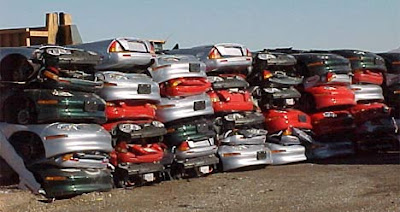
        Maybe that had a factor with GM's corporate suddenly "pulling the plug" on their EV development, crushing hundreds of thousands of almost new vehicles. Yes they donated a few to schools and museums but only empty shells without any trace of drive train.
        I don't know. I guess we could find conspiracy in a lot of things.


        Some EV1 specs
        Review of an EV1 from an actual driver
        A test car without the governor has done 183 mph. It's QUICK! 0-30 in 3 seconds, 0-60 in 8 seconds.
        Sorry to derail so far away from solar, but the EV1 is a real hot spot with me.

        Comment

        • Sunking
          Solar Fanatic
          • Feb 2010
          • 23301

          #5
          Steve I share your enthusiasm for EV's. We have all but one piece of the technology to have mass market appeal, the battery.

          Right now it is possible to make a 4-door passenger car with a 300 mile range, and all the bells and whistles like AC and heat. However with current battery technology it drives the price up beyond most consumers reach Tesla Roadster is living proof it can be done, but at $100K per car.

          Once we have a battery technology of that can provide a minimum of 200 wh/kg, @ $1 per watt hour price, EV's will be at parity with ICE autos. The big advantage is the EV fuel cost will be much much lower than ICE fuels.

          Good news is the technology is close, and I am confident already in the prototype phase. Today you can get a LiFe4P0 battery with a density of 105 wh/kg @ $$.50 per wh storage. Only real big problem IMHO it will be the Chinese making them and monopolize the market.
          MSEE, PE

          Comment

          • Mike90250
            Moderator
            • May 2009
            • 16020

            #6
            Originally posted by Sunking
            Once we have a battery technology of that can provide a minimum of 200 wh/kg, @ $1 per watt hour price, EV's will be at parity with ICE autos. The big advantage is the EV fuel cost will be much much lower than ICE fuels.
            The NiMh batteries are very close to being a perfect car battery, but the GM patent prevents them from being used in cars !!
            Toyota RAV4s with 60K miles on the battery pack, are still in good shape.
            Powerfab top of pole PV mount (2) | Listeroid 6/1 w/st5 gen head | XW6048 inverter/chgr | Iota 48V/15A charger | Morningstar 60A MPPT | 48V, 800A NiFe Battery (in series)| 15, Evergreen 205w "12V" PV array on pole | Midnight ePanel | Grundfos 10 SO5-9 with 3 wire Franklin Electric motor (1/2hp 240V 1ph ) on a timer for 3 hr noontime run - Runs off PV ||
            || Midnight Classic 200 | 10, Evergreen 200w in a 160VOC array ||
            || VEC1093 12V Charger | Maha C401 aa/aaa Charger | SureSine | Sunsaver MPPT 15A

            solar: http://tinyurl.com/LMR-Solar
            gen: http://tinyurl.com/LMR-Lister

            Comment

            • Sunking
              Solar Fanatic
              • Feb 2010
              • 23301

              #7
              Originally posted by Mike90250
              The NiMh batteries are very close to being a perfect car battery
              I disagree with that for one reason, the Energy Density of NiMh is 40 to 60 wh/kg which is about the same as lead acid batteries. NiMh can be fully discharged without damage unlike Lead Acid batteries, but energy density is about the most important aspect when it comes to an EV as it determines the overall weight if the vehicle. LiFeP04 energy density is in the 90 to 130 /wh kg or about twice that of NiMh but still short of the mark needed to give an EV a range of say 200 to 300 miles.

              Cobalt Lithium toady has 220 wh/kg which is what Tesla uses in their vehicles, but cobalt cannot be charged or discharged at high rates, and are prone to over heating and exploding.Tesla got around this problem with a very expensive BMS

              Originally posted by Mike90250
              GM patent prevents them from being used in cars
              That is not true, GM does not own the patent, Texaco bought it from GM in 2000, and one week later Chevron bought Texaco and the patent went to Chevron's Cobasys division. When GM owned the patent they let any manufacture use the technology like the RAV4 and Dodge Caravan Epic. Here is the source info
              MSEE, PE

              Comment

              • Mike90250
                Moderator
                • May 2009
                • 16020

                #8
                With the twisted pedigree of the ECD, GM-Ovonics, Texaco, Chevron, Cobasys large format NiMh battery, it's easy to mistake who (Big Oil) prohibited who (car company's) from using the batteries in banks for vehicle use. Sorry.

                But the NiMh can easily be managed, to 99% discharged, where the LiIon can only be 50% , and there the weight penalty disappears, since you need twice as much battery.
                Ironically, NiMH has a higher effective energy density than Lithium.

                From my friend with a 2002 Rav4 : "We still get over 100 miles range after 100,000 miles, 5-passengers, battery under the vehicle, can carry 1000 lbs. of tools and completely trouble-free. Engineering on the Toyota RAV4-EV essentially stopped in 1997; think how advanced we would be except for Chevron's killing of NiMH (GM cooperated and helped Chevron)."
                Powerfab top of pole PV mount (2) | Listeroid 6/1 w/st5 gen head | XW6048 inverter/chgr | Iota 48V/15A charger | Morningstar 60A MPPT | 48V, 800A NiFe Battery (in series)| 15, Evergreen 205w "12V" PV array on pole | Midnight ePanel | Grundfos 10 SO5-9 with 3 wire Franklin Electric motor (1/2hp 240V 1ph ) on a timer for 3 hr noontime run - Runs off PV ||
                || Midnight Classic 200 | 10, Evergreen 200w in a 160VOC array ||
                || VEC1093 12V Charger | Maha C401 aa/aaa Charger | SureSine | Sunsaver MPPT 15A

                solar: http://tinyurl.com/LMR-Solar
                gen: http://tinyurl.com/LMR-Lister

                Comment

                Working...