-
Interesting. So I should bolt all the positive sides to a single point and the same with the negative and then go to the charge controller? There is space as far as the charge controller goes to bolt them to the cables. It's a loop end and I have a terminal bolt going through it which fits all the battery terminals. I figured one more cable in between them is just that much more waste. -
I don't know that the charge controller terminals are the right place to combine all the wires, usually space is limited and the terminal is only rated for one wire, not several.Leave a comment:
-
So I've done the 3 pattern as referenced on this website.
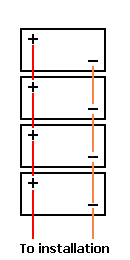
I have all the same terminal wires from all the positive terminal posts bolted directly to the positive side of the solar controller and the same with negative side. On the website it shows all the wires going to a terminal and then from that terminal to the solar controller. I think bolting all the positive wires together to the positive cable wire of the solar charger and the same for the negative side is the same effect but maybe I'm wrong. Seems like that would even the charging out as opposed to the second pattern and make the batteries last longer but I could be wrong.
As far as the wireless on off switch I've pretty much just given up on that. Seems like there isn't a simple solution to that problem except to buy a better inverter with that feature. Since I just got the Bestek 1000 watt inverter which fits my needs for now. Thanks for all the help! I think the new battery wiring will help keep them good for a while.Leave a comment:
-
Its usually easy enough to remove the panel of an inverter to get at the on off switch.. Its only low voltage very low current so the two wires can easily be extended to about 50m no problem
A 1000 w inverter can sometimes have a self power use as high as 2a.. Thats 48ahr a day. a lot on a small solar panel/battery system.
If you want a simple wireless solution do this .but you stil have to access and extend the two wires to the inverter on off switch.. Go to a garage door supplier and buy a wireless receiver and wireless remote on off switch.. not expensive. and easy to use.Leave a comment:
-
You can try that "diagnol" pattern that Mike showed you. That should make it a little better.
When this set of batteries finally die, you should look into getting batteries at the desired Ah rating in lower voltages like 2, 4 or 6v. Then you build your battery system by wiring them all in series.
I could have used 2 x 6volt 232 Ah FLA batteries to make a 12volt 232 Ah system instead of the 4 x 12volt 50Ah AGM batteries that made a 12v 200 Ah system. I spent twice as much with those 4 x 50Ah batteries and will get less Watt hour capacity then using the 6 volt with a higher Ah rating.Leave a comment:
-
-
I also didn't understand and wired 4 x 12volt 50Ah in parallel before I found out about the imbalance due to resistance issue.
Your system will work for a while but at some point either one in the middle or at each end will start to fail. You will not get the full life out of them.Leave a comment:
-
So by saying the same terminations do you mean the exact same wiring cables? I'm sure there can be a little difference in resistance from cable to cable even if it's the same cable but by doing that they would charge and discharge better? I had no idea wiring up solar batteries in parallel was so complicated.Leave a comment:
-
The problem with wiring in parallel is all of those terminations need to have the same resistance. Even if one was a few ohms more than the others the current flow would not be even to all the batteries. That means they will not discharge or charge evenly so one battery will get "worked over" more than the others causing it to fail sooner. Once one battery starts to go the entire bank starts to slip to an early death.
When batteries are wired in series they all have a better chance of being charged and discharged evenly so they perform the same amount of work as a team.Leave a comment:
-
That website about the parallel wiring was really interesting. Sounds like the second method is fine for batteries under a total of 8 or if the batteries aren't very expensive. Good to know though. That's a really good write up.Leave a comment:
-
For a small inverter, I suppose the remote switch in the video will work. But above a couple hundred watts, the power in the wire will fry the module.
12V 200w = 16a and 10 ga wire
12v 400w = 33a and 8 ga wire Above that, and the little wires on the module will get all melty and burned.
edit - after getting the entire video to load and play, I see the inverter gets opened up and the remote spliced into the place of the front panel switch. This takes it out of the high amp path, and is less of a fire hazard.Leave a comment:
-
connecting batteries on the "Diagonal" is the best way to connect 2 in parallel, but that does not mean it's the best way to use the batteries. There is a large write up here
about the math behind the difficulties of parallel batteries.Leave a comment:
-
So you can only have two 12 volt batteries in parallel if you want them to last? I though you could just hook the positive side battery hook up from the solar controller to the first battery and the negative side battery hook up from the solar controller to the negative side battery last in the chain? Wouldn't that balance out charging them? Shows how much I have to learn!Leave a comment:
-
All DC to AC inverters always draw some power. They usually have a "no-load" rating in watts or amps or a % of the Inverter watt rating. The cheaper models are less efficient and use more wattage.
Easiest way to reduce waste is to just turn off power button on the inverter.
You can measure the amperage using a DC clamp on meter in the wires between the battery and inverter. That way you can compare how much is being drawn when the inverter has a load, has no load or is turned off.
Here is a hint about batteries. More than 2 wired in parallel will cause an imbalance in how they are charged and discharged which results in one or more failures. Having 5 car 12volt batteries in parallel will cause them to have a very early death.Leave a comment:
-
Thanks for the video! That's a pretty cool hack. I just assumed that there was some device out there that would do this. Doesn't seem that complicated. Is there a way to tell if the inverter is still sucking power from batteries when power switch is off? It may draw some current but it must be pretty minimal so I'm thinking of just turning the power button off when not in use but if disconnecting the leads is better for the batteries I can do that as well. Just wondering if anyone has any experience with that. Thanks for the replies! I'm super new to solar power!Leave a comment:


Working...
😀
😂
🥰
😘
🤢
😎
😞
😡
👍
👎
☕
Leave a comment: